Uncanny valley=things that aren’t normal almost getting it right
Third person limited view
Limited explanations
Rot, mold, damage, age, static, flickering, especially in places it shouldn’t be
Limited sights for your mc -blindness, darkness, fog, refuse
Real consequences
Being alone -the more people there are, the less scary it is
Intimate knowledge, but only on one side
I don’t know I just write scary things but I don’t know what I’m doing.
Rule of Thumb: your reader’s imagination will scare them more than anything you could ever write. You don’t have to offer a perfectly concrete explanation for everything at the end. In fact, doing so may detract from your story.
Tips for writing an essay with executive dysfunction: do this.
Write out bits and pieces of the essay. When you get to a part you can’t/”don’t want to” write, put it in bold brackets. Get as much done as you can and come back in a half an hour or so!
If the executive function is still bothering you, take it one bracket at a time. Don’t delete the bracket until you’re done “filling it in,” so to speak. If you need to take more breaks or hop to the next bracket, you can do that too! Similarly, if you have a thought you want to get down but you aren’t sure how to word it, put it in bold brackets as well!
It may not “cure” the executive dysfunction or procrastination problems, but it makes writing the essay more like putting shapes in holes of the same shape. It can be a pain, but the process is a bit more streamlined and user-friendly.
I know this may not work for everyone, but as someone who has really bad executive dysfunction and problems focusing (thank you, ADHD!) this works REALLY well for me! I hope by sharing it it can help other people (with and without executive dysfunction/adhd) too! o/
This strategy also works for individual words as well. Not sure what works to put? In its place, put a bracket and fill it in. I often use a synonym of the word I want to go there because it helps me know what to fill in later, but there have also been times when I’ve just put [word] to signify that I know some word needs to go there, but I’m not sure what at the moment.
To make sure that you’ve cleared all the brackets before turning in your assignment, you can use the search function and just type a single bracket in. Once your search returns no brackets, you know that it’s ready!
You’ve heard of “making writing a habit,” and you’ve tried, but the pressure to write fills you with horrible pain and dread. You spend all your time wishingyou could write but somehow never writing. The “make it a habit” approach doesn’t work for you. But you still wantto write, maybe even regularly. Is there nothing you can do?
Here is an alternative approach to try. A rehab program, as it were, for writers with a psychological “writing injury” that has destroyed their desire to write and replaced it with shame, anxiety and dread.
If you have a writing injury, you probably acquired it by being cruel to yourself, by internalizing some intensely critical voice or set of rules that crushes your will to write under the boot-heel of “you should.” “You should be writing better after all the years of experience you’ve had.” “You should be writing more hours a day, you’ll never get published at this rate.” “You should write more like [Hilton Als/Jeffrey Eugenides/Octavia Butler/Terry Pratchett/etc.].” “You should write faster/more/better/etc./etc.”
You know what, though? Fuck all that. Self-abuse may have featured heavily in the cool twentieth-century writer’s lifestyle, but we are going to treat ourselves differently. Because 1) it’s nicer, and 2) frankly, it gets better results. My plan here is to help you take the radical step of caring for yourself.
1) First of all: ask yourself why you aren’t writing.
Not with the goal of fixing the problem, but…just to understand. For a moment, dial down all of the “goddammit, why can’t I just write?”blaringin your head and be curious about yourself. Clearly, you havea reason for not writing. Humans don’t do anything for no reason. Try to discover what it is. And be compassionate; don’t reject anything you discover as “not a good enough excuse.” Your reasons are your reasons.
For me, writing was painful because I wanted it to solve all my problems. I wanted it to make me happy and whole. I hated myself and hoped writing would transform me into a totally different person. When it failed to do that, as it always did, I felt like shit.
Maybe writing hurts because you’ve loaded it with similarly unfair expectations. Or maybe you’re a victim of low expectations. Maybe people have told you you’re stupid or untalented or not fluent enough in the language you write in. Maybe writing has become associated with painful events in your life. Maybe you’ve just been forcedto write so many times that you can no longer write without feeling like someone’s making you do it. Writing-related pain and anxiety can come from so many different places.
2) Once you have some idea of why you’re not writing…just sit with that.
Don’t go into problem-solving mode. Just nod to yourself and say, “yes, that’s a good reason. If I were me, I wouldn’t want to write either.” Have some sympathy for yourself and the pain you’re in.
3) Now…keep sitting with it. That’s it, for the moment. No clever solutions. Just sympathize. And, most importantly, grant yourself permission to notwrite, for a while.
It’s okay. You are good and valuable and worthy of love, even when you aren’t writing. There are still beautiful, true things inside of you.
Here’s the thing: it’s very hard for humans to do things if they don’t have permission notto do them. It’s especially hard if those things are also painful. We hate feeling trapped or compelled, and we hate having our feelings disregarded. It shuts us down in every possible way. You will feel more desire to write, therefore, if you believe you are free not to write, and if you believe it’s okaynot to do what causes you pain.
(By the way: not having permission isn’t the same as knowing there will be negative consequences. “If I don’t write, I won’t make my deadline” is different from “I’m not allowed not to write, even if it hurts.” One is just awareness of cause and effect; the other is a kind of slavery.)
4) For at least a week, take an enforced vacation from writing, and from any demands that you write. During this time, you are not permitted to write or give yourself grief for not writing.
This may or may not be reverse psychology. But it’s more than that.
Think of it as a period of convalescence. You’re keeping your weight off an injury so it can heal, and what’s broken is your desire to write. Pitilessly forcingyourself to write when it’s painful, plus the shame you feel when you don’t write, is what broke that desire. So, for a week (or a month, or a year, or however long you need) tell yourself you are taking a doctor-prescribed break from writing.
This will feel scary for some folks. You might feel like you’re giving up. You might worry that this break from writing feels too good, that your desire to write might never return. All I can say is, I’ve been there. I’ve had all those fears and feelings. And the desire to write did return. But you gotta treat it like a tiny crocus shoot and not stomp on it the second it pokes its little head up. Like so:
5) Once you feel an itch to write again—once you start to chafe against the doctor’s orders—you can write a tiny bit. Only five or ten minutes a day.
That’s it. I’m serious: set a timer, and stop writing when the time’s up. No cheating. (Well…maybe you can take an extra minute to finish your thought, if necessary.)
Remember: these rules are not like the old rules, the ones that said, “you must write or you suck.” These rules are a form of self-care. You are not imposing a cruel, arbitrary law, you are being gentle with yourself. Not “easy” or “soft”—any Olympic athlete will tell you that hard exercise when you’ve got an injury is stupid and pointless, not tough or virtuous. If you need an excuse to take care of yourself, that’s it: if you’re injured, you can’t perform well, and aggravating the injury could take you out of the competition permanently.
For the first few days, all of the writing you do should be freewriting. Later, you can do some tiny writing exercises. Don’t jump into an old project you stalled out on. Think small and exploratory, not big and goal-oriented. And whatever you do, don’t judge the output. If you have to, don’t even read what you write. This is exercise, not performance; this is you stretching your atrophied writing muscles, not you trying to write something good. At this stage, it literally doesn’t matter what you write, as long as you generate words. (Frankly, it would be kind of weird and unfair if your writing at this point was good.)
6) After a week, you can increase your time limit if you want. But only a little!
Spend a week limiting yourself to, say, twenty minutes a day instead of ten. When in doubt, set your limit for less than you think you’ll need. You want to end each writing session feeling like you couldkeep going, not like you’re crawling across the finish line.
Should you write every day? That’s up to you. Some people will find it helpful to put writing on their calendar at the same time each day. Others will be horribly stifled by that. You get to decide when and how often you write, but two things: 1) think about what you, personally, need when you make that decision, and 2) allow that decision to be flexible.
Remember, the only rule is, don’t go over your daily limit. You always have permission to write less.
And keep checking in with yourself. Remember how this program began? If something hurts, if your brain is sending you “I don’t wanna” signals, respect them. Investigate them, find out what their deal is. You might decide to (gently) encourage yourself to write in spite of them, but don’t ignore your pain. You are an athlete, and athletes listen to their bodies, especially when they’re recovering from an injury. If writing feels shitty one day, give yourself a reward for doing it. If working on a particular project ties your brain in knots, do a little freewriting to loosen up. And always be willing to take a break. You always have permission not to write.
7) Slowly increase your limit over time, but always have a limit.
And when you’re not writing, you’re not writing. You don’t get to berate yourself for not writing. If you find yourself regularly blazing past your limit, then increase your limit, but don’t set large aspirational limits in an effort to make yourself write more. In fact, be ready to adjust your limit lower.
When it comes to mental labor, after all, more is not always better. Apparently, the average human brain can only concentrate for about 45 minutes at a time, and it only has about four or so high-quality 45-minute sessions a day in it. That’s three hours. So if you set your daily limit for more than three hours, you may be working at reduced efficiency, when you’d be better off saving up your ideas and motivation for the next day. (Plus, health and other factors may in fact give you less than 3 good hours a day. That’s okay!)
Of course, if you’re a professional writer or a student, external pressures may force you to write when your brain is tired, but my point is more about attitude: constant work is not necessarily better work. So don’t make it into a moral ideal. We tend to think that working lessis morally weak or wrong, and that’s bullshit. Taking care of yourself is practical. Pushing yourself too hard will just hurt you and your writing. Also, your feelings are real and they matter. If you ignore or abuse them, you’ll be like a runner trying to run on a broken ankle.
I know I’m going to get someone who says, “if you’re a pro, sometimes you gotta ignore your feelings and just get the work done!”
NO.
You can, of course, choose to work in spite of any pain you’re feeling. But ignore that pain at your peril. Instead, acknowledge the pain and be compassionate. Forgive yourself if pain slows you down. You are human, so don’t hold your feet to the fire for having human limitations. Maybe a deadline is forcing you to work anyway. But make yourself a cup of hot chocolate to get you through it, literally or metaphorically. Help yourself, don’t force yourself. If you’ve had a serious writing injury, that shift in attitude will make all the difference.
In short: treat yourself as someone whose feelings matter.
If y’all use a decent box mix and use melted butter instead of vegetable oil, an extra egg, and milk instead of water, no one can tell the difference. I sure as hell can’t.
Also, if you add a little almond extract to vanilla cake, or a little coffee to chocolate cake, it sends it through the roof.
This concludes me attempting to be helpful.
yo I can vouch for this I’ve done this for the last few cakes I’ve made and holy crap it makes suuuuch a difference the cake is still fluffy, but it also seems more dense, and it doesn’t dry out like at all you can leave it uncovered on the counter all day after being cut into, and it won’t get all crusty and dry this is an amazing way to take your cakes to the next level
Does this count as cake hacks?
cake: hacked
OK but if you’re adding all that to the mix why not just scratch bake? There are literally only four ingredients you’re NOT adding yourself at this point.
It’s always so baffling when mix hackers give you a whole ass cake recipe. Like there’s some kind of magic to mixes that needs to form the core of the thing instead of just, a couple dry ingredients and powdered milk.
presumably as a step of intermediate complexity between mix baking and scratch baking, when neither of those fits your complexity needs exactly?
In particular, this is a useful technique for people living in dorms, or traveling, or similar situations!
Baking from scratch means you’ve got to buy a whole tin of baking powder and only use a spoonful, and a whole thing of flour, and maybe multiple kinds of sugar, and maybe cocoa powder, maybe spices, and there’s no way you’re going to use up any of those, you’ll just have to pitch them when you move out.
Not to mention that you’ve got maybe one measuring cup, and there’s no way you’ve got a sifter, and you probably don’t have measuring spoons and how sure are you that your eating spoon is actually the right size…
Scratch baking is great if you’re going to do it regularly! But for situations where it doesn’t make sense to invest in all the tools and ingredients, cake mixes are very practical.
Scratch means you have to worry about ratios. Scratch means you have to keep cake flour on hand. Scratch means you don’t get the benefit of some of the CHEMICALS in the mix that are 100% beneficial to excellent cake.
I bake some things from scratch. Anything requiring creaming a mix is basically a sad joke because all the work is the creaming. Standard cake is not one of them.
Of course, me being me, a standard cake is usually just a component – I don’t actually like “just cake” that much and canned frosting is terrible. So while I don’t scratch bake cake, that cake is getting saturated with tres leches, or put in a trifle, or getting add-ins before baking anyway.
But in a larger sense, who cares? Baking is hard and for fun anyway. Why bake-shame someone?
Just FYI… A LOT of professional bakers (probably more than half) in the US at least use doctored mixes rather than scratch ingredients even for their more expensive cakes like wedding cakes. There are whole forums where they talk about this amongst themselves.
In taste tests they’ve found that while customers may ask for a cake from scratch they often end up preferring the taste and texture of the doctored mixes when all is said and done.
Unless you have some particular allergies or some other reason to avoid box mixes they are often the better way to go.
I’ve been looking into opening up a home bakery and part of the task of producing food for the public is making sure your items are standardized so that every person who gets a cupcake (for instance) is getting the same quality, size, etc., etc.
Doctored mixes really help with that since big companies like Duncan Hines buys in larger quantities, can afford to test/discard bad batches and will rarely have a one-off batch of flour or flavoring that are bad or go bad like you can at home.
Nice seeing this going around again!
My standard cake is box mix + milk for water + melted butter for oil + dash vanilla extract + frosting from scratch. This really seems to hit the right spot for people of “mmm, homemade” but also “exactly like Mom used to make.” (Do that for a yellow cake with chocolate buttercream frosting, add candles, and serve to a college student, for the maximum “this is exactly what I didn’t want to admit I wanted” potential.)
Seconding the addition of coffee to chocolate cake; a tablespoon of instant coffee powder in a dark chocolate cake makes it taste chocolatey-er without actually adding a perceptible coffee flavor (I don’t like coffee flavor, personally, and I still do this).
Another good option is a box lemon cake mix plus maybe 3 lemons. Zest the lemons, set the zest aside, then juice them and use that in place of the water; then use the zest to flavor the frosting. Adds a nice fresh kick.
Chocolate chips can be dumped straight into chocolate cake mix without fussing with anything to compensate. Sprinkles can go into white cake mix to make your own “confetti cake” with any specific color combo you like. Any kind of dried fruit can be chopped to raisin-size, soaked in hot water (or, better yet, hot juice with a couple of citrus peels added) for an hour, drained, and then added to batter.
Replacing part (up to maybe 1/3) of the water with yogurt (and then the rest with milk as usual) will give you a denser cake; make sure to check if it’s cooked through, and bake a little longer if necessary.
Swirling things through batter for that fancy marbled look is easy. Consider melting chocolate chips with butter, or mixing brown sugar with cinnamon and a little melted butter, or making up two different cake mixes and swirling those together.
I swear by the Cake Mix Doctor’s two cookbooks (one’s general, one’s specifically for chocolate cakes). I think every birthday cake I had as a child was out of those.
I started in my early days by using Betty Crocker mixes – an expensive import in Northern Ireland at the time, but very convenient since some of them were complete kits including a foil cake-tin. They also included cakes I’d never heard of – Red Velvet, Devil’s Food and Angel Food (why not Angel’s Food?)
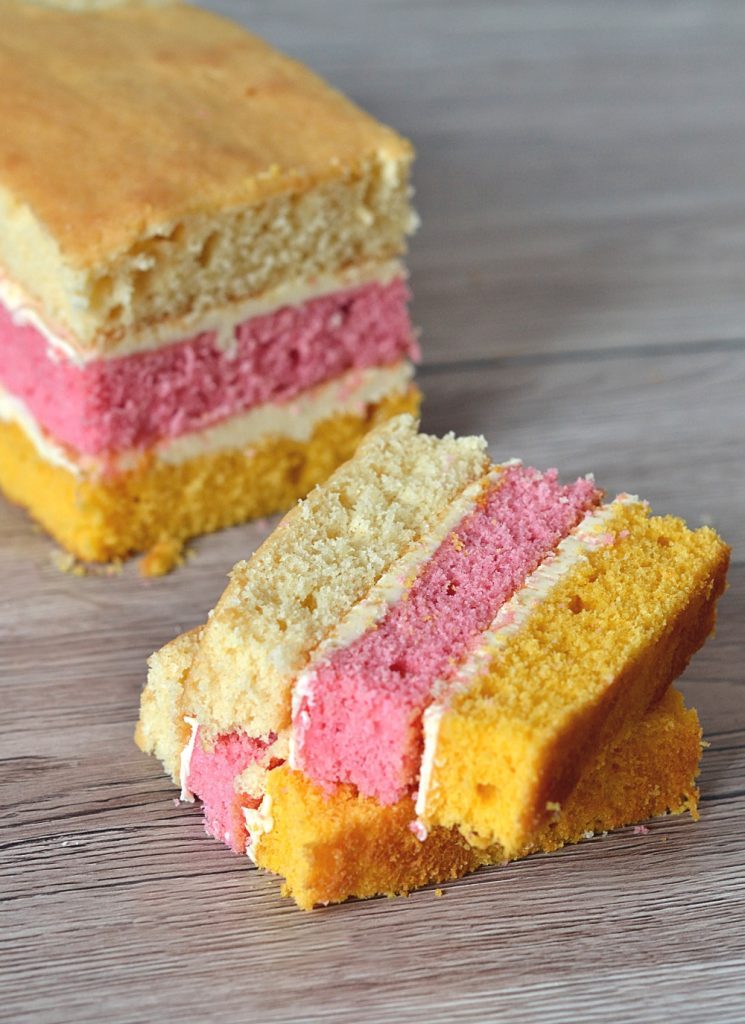
NB, Angel Cake over here is a completely different thing made up of coloured layers.
After a while, with my Mum’s help, I started tweaking with an extra egg here, a bit of cream there, and the results were always good.
Though @dduane is a far better
cake-baker than I’ll ever be, she also uses mixes to see how they stack up
against made-from-scratch versions especially if the mixes produce something
Really Nice – like, for instance, Betty Crocker brownies – or are more convenient with no huge drop in quality…..
Here’s an example: about 10 years ago
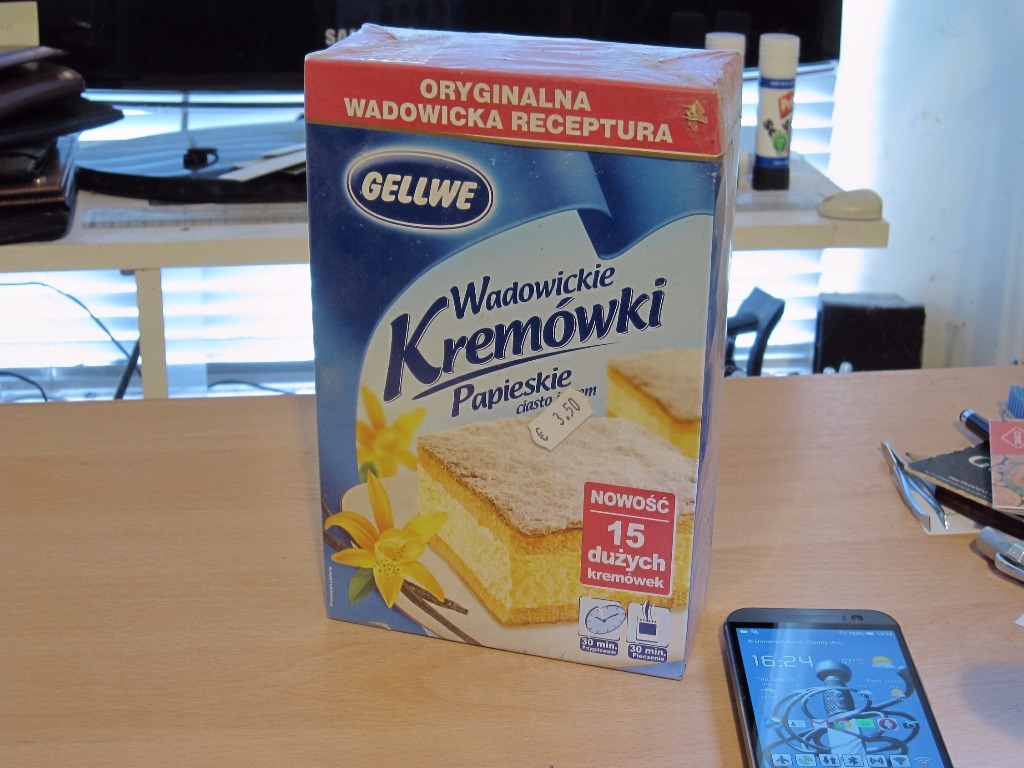
Kremówka Papieska / “The Pope’s Cream Cake” was mentioned as one of the EU 50th-birthday cakes, and DD made it from scratch.
A bit later we found Gellwe-brand mix in one of our local branches of Polonez, and tried that too. The home-made one was definitely better, but the boxed version was also very good, needed only basic extras – milk, butter, sugar etc. – and took far less time to make (though after tasting the custard we added a bit extra vanilla extract…)
That’s why we still have a box in the store-cupboard.
Just in case one or both of us feel like pontifficating… :->
I find that if I’m wearing Real Adult Business Clothes my worksona can do things like call people and check my inbox, whereas pajamas hellen mostly wants to shovel hamburgers into her face and set things on fire.
Tbh pajamas Hellen sounds like a hell of a good time
pajamas hellen has caught on fire twice. she’s an idiot.
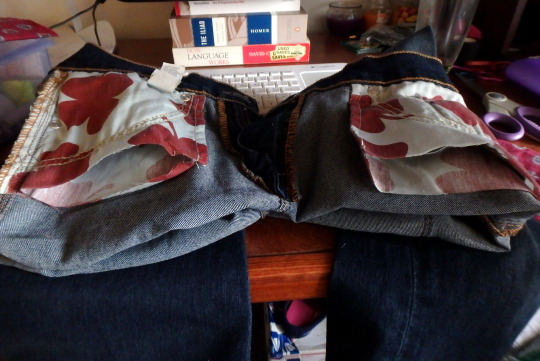
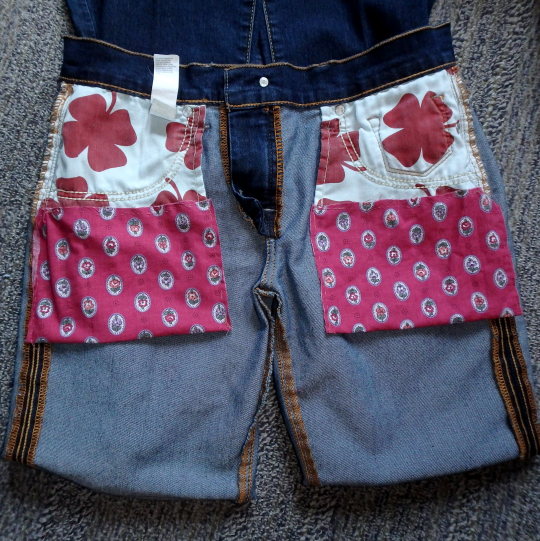
So I don’t know about you, but I’m often frustrated by the ridiculous smallness of girls’ pockets. At a bare minimum, I need to be able to shove my cellphone in there – come on, pants companies! So what I started doing was making myself pocket extenders. I’ve done this several times, for pants and shorts. It’s great.
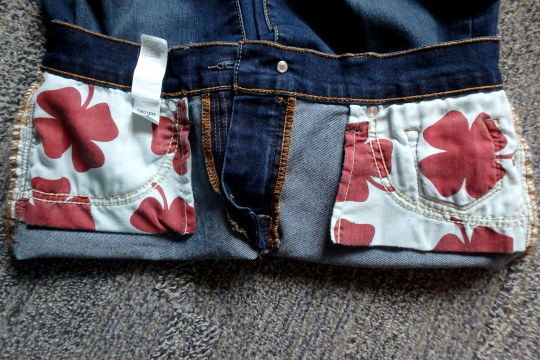
I just got this pair of jeans, so I thought I’d show you how to do it. I kind of feel like it just hasn’t occurred to some of you that this is an option, so maybe now it will. All you need is your pants, some fabric (I just took a random piece from a scrap bin), a needle, and some thread (thread doesn’t even need to match the fabric since literally no one will see it).
See? Ridiculous. Like, half a cellphone, or only 2.5″. Useless.
So turn those inside out to expose the pockets.
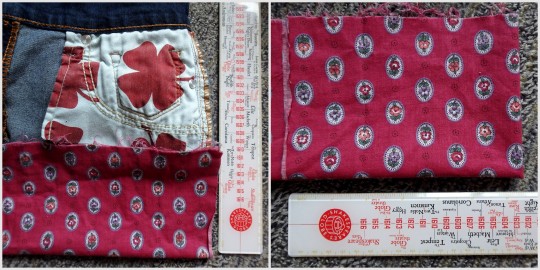
Figure out how big you want your pockets to actually be. I kinda go by whatever looks like might be right. I didn’t
really measure them. Fold the fabric in half, so you have a pocket, and
then fold it in half again so you can have two equal ones.
Try to get the edges to line up enough, pin it in place, then sew up the sides! Are your stitches crazy uneven and wonky looking? Doesn’t matter; nobody’s going to see it. These are in the inside of your pants. The only thing that matters is that it holds up. So I double-did the corners, since those tend to get the most stress.
Cut open the bottom of the existing pockets.
Pin it in place, then sew around, joining the new pocket to the old pocket. I did this by keeping my hand on the inside, so I wouldn’t accidentally sew through the other side. Again, I reinforced the corners, and didn’t worry about what it actually looks like. Then I turned it in side out to make sure the inside was all joined properly.
Yay all done! And the pockets are so much bigger now!
Whaaaat I can fit my entire phone and entire hand and probably something else now, are girls’ pockets even allowed to do that?! Heck yeah they are.
You are a goddamn hero.
The fashion industry just needs to catch the fuck up!
The fashion industry wants to sell you pants AND a purse. They’ve made a conscious decision not to catch up.
Today I discovered this writer’s tactic to face her fear of rejection and failure, and it’s honestly very inspiring?! This kinda rewired my brain and I feel everyone should read and think about it.
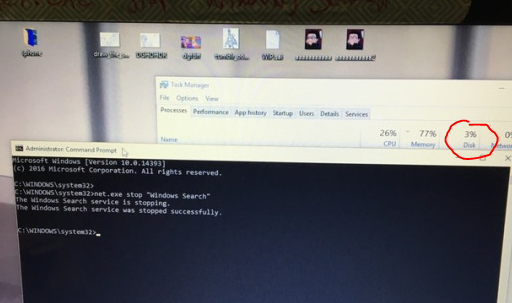
y’all didn’t even add a tutorial of how to do this so imma put one right here
1. type in cmd.exe into your windows search and right click on Command Promt search result and select “Run as Administator”. 2. Type/Copypase in
net.exe stop “Windows Search” and make sure Windows Search is in quotations. It should then respond saying “The Windows Search service is stopping” and then tell you it’s stopped.
This is only a temp fix though, if you want it switched off permanently then do THIS:
1. Press the Windows key + R at the same time and type in services.msc.
2. Scroll until you find Windows Search and double click it to enter its Properties window.
3. Change the Startup type to Disabled. Apply this change and you can exit out.
My
gf of 3 years is the queen of “wherever” and “I don’t care” when it
comes to this. This little game fixed our problem immediately. It takes
the pressure off of her, but still gives her a choice about where to
eat.
(this can also work with kids and indecisive friends)








 Consulting Witch