popthirdworld:

“When I was 26, I went to Indonesia and the Philippines to do research for my first book, No Logo.
I had a simple goal: to meet the workers making the clothes and
electronics that my friends and I purchased. And I did. I spent evenings
on concrete floors in squalid dorm rooms where teenage girls—sweet and
giggly—spent their scarce nonworking hours. Eight or even 10 to a room.
They told me stories about not being able to leave their machines to
pee. About bosses who hit. About not having enough money to buy dried
fish to go with their rice.

They knew they were being badly exploited—that the garments
they were making were being sold for more than they would make in a
month. One 17-year-old said to me: “We make computers, but we don’t know
how to use them.”

So one thing I found slightly jarring was that some of these
same workers wore clothing festooned with knockoff trademarks of the
very multinationals that were responsible for these conditions: Disney
characters or Nike check marks. At one point, I asked a local labor
organizer about this. Wasn’t it strange—a contradiction?

It took a very long time for him to understand the question.
When he finally did, he looked at me like I was nuts. You see, for him
and his colleagues, individual consumption wasn’t considered to be in
the realm of politics at all. Power rested not in what you did as one
person, but what you did as many people, as one part of a large,
organized, and focused movement. For him, this meant organizing workers
to go on strike for better conditions, and eventually it meant winning
the right to unionize. What you ate for lunch or happened to be wearing
was of absolutely no concern whatsoever.

This was striking to me, because it was the mirror opposite
of my culture back home in Canada. Where I came from, you expressed your
political beliefs—firstly and very often lastly—through personal
lifestyle choices. By loudly proclaiming your vegetarianism. By shopping
fair trade and local and boycotting big, evil brands.

These very different understandings of social change came up
again and again a couple of years later, once my book came out. I would
give talks about the need for international protections for the right
to unionize. About the need to change our global trading system so it
didn’t encourage a race to the bottom. And yet at the end of those
talks, the first question from the audience was: “What kind of sneakers
are OK to buy?” “What brands are ethical?” “Where do you buy your
clothes?” “What can I do, as an individual, to change the world?”

Fifteen years after I published No Logo, I still
find myself facing very similar questions. These days, I give talks
about how the same economic model that superpowered multinationals to
seek out cheap labor in Indonesia and China also supercharged global
greenhouse-gas emissions. And, invariably, the hand goes up: “Tell me
what I can do as an individual.” Or maybe “as a business owner.”

The hard truth is that the answer to the question “What can
I, as an individual, do to stop climate change?” is: nothing. You can’t
do anything. In fact, the very idea that we—as atomized individuals,
even lots of atomized individuals—could play a significant part in
stabilizing the planet’s climate system, or changing the global economy,
is objectively nuts. We can only meet this tremendous challenge
together. As part of a massive and organized global movement.

The irony is that people with relatively little power tend
to understand this far better than those with a great deal more power.
The workers I met in Indonesia and the Philippines knew all too well
that governments and corporations did not value their voice or even
their lives as individuals. And because of this, they were driven to act
not only together, but to act on a rather large political canvas. To
try to change the policies in factories that employ thousands of
workers, or in export zones that employ tens of thousands. Or the labor
laws in an entire country of millions. Their sense of individual
powerlessness pushed them to be politically ambitious, to demand
structural changes.

In contrast, here in wealthy countries, we are told how
powerful we are as individuals all the time. As consumers. Even
individual activists. And the result is that, despite our power and
privilege, we often end up acting on canvases that are unnecessarily
small—the canvas of our own lifestyle, or maybe our neighborhood or
town. Meanwhile, we abandon the structural changes—the policy and legal
work— to others.”

Naomi Klein, “Climate Change Is a Crisis We Can Only Solve Together”

princessnijireiki:

thelnfinitywar:

lord-kitschener:

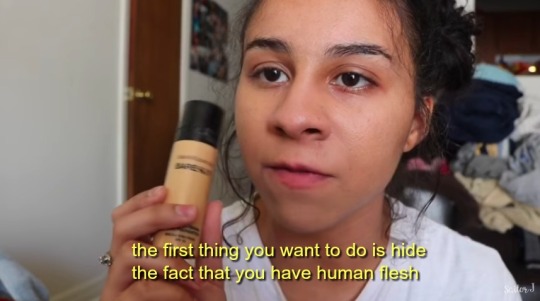
I just saw some article about how leg makeup is a summer beauty essential, and that’s how I know we’re in hell! Ladies, it’s your duty to #empower yourself by covering your entire fucking body in a sarcophagus made of contoured concealer ($275.50 from sephora) so that the general public doesn’t end up vomiting en Masse and forever shunning you after being forced to witness how unforgivably disgusting, offensive, ugly, and un-instagrammable your uncovered skin is!!!!!

I saw some products the other day labeled “workout-ready makeup"— not just waterproof or sweatproof, which would make sense, because I live in Florida (it’s hot, sweat-proof anything is important, right up there with sunblock sometimes); or even euphemistically referring to sex, because this makeup was packaged and shelved alongside the sort of “teenybopper” makeup selections aimed at junior high & high school girls.

No, it was marketed under the concept… that one needed makeup to be ready to work out, and which would itself outlast that workout. Stuff like blush & contour… not waterproof mascara or anything, but on top of that, to make sure your cheekbones & nose look shaped up before you hop on a treadmill.

Who the fuck is that performance for? Why the fuck is that even a thing, let alone a thing some people (including kids) are gonna see & fully think is necessary?

LISTEN UP

sushinfood:

rahafwabas:

dontbugmeimantisocial:

I’m American. I live right in the southwest and let me tell you, it’s hell over here right now, but it will become a lot worse if Article 13 is passed. 

You’ve probably heard about Article 13, and if you haven’t, go watch this video right now. Whatever you’re doing can wait for sixteen minutes and two seconds, because a second-long vote could destroy everything online.

Whether you’re from Europe or not, this law could affect you, so you should care Article 13 because it is going to destroy the online lives that you have built. No more posting memes, no more remixes, and no more YouTubers from anywhere. 

Jacksepticeye will no longer be able to upload. 

Markiplier will no longer be able to upload. 

MatPat won’t.

Thomas Sanders.

Dan and Phil.

How to Basic. 

All of your favorite content creators are at risk of losing their jobs because people want stricter laws on copyright, which will support the larger media companies but kill smaller creators. And because of this, we may lose everything online. 

So spread the word! Reblog this, reblog other people’s posts, find petitions, write your own posts! If you’re in Europe, contact your MEP’s and get them to understand how it will affect the people who use the internet. 

Please. 

#savetheinternet. 

Please stop and read this

This is important !!!

This video actually very clearly explains why this isn’t just about “the end of all memes” and everyone really should be watching this.

Save the internet now

awakening-girl:

https://www.change.org/p/saveinternet Please, go to this site and put your name on this petition. It’s for stopping Article 13, an EU thing that likely will kill memes and AMVs, actually the whole internet culture. This article basically says that the site that allows an copyrighted upload will be held responsible. If that dosen’t sound scary then let me give an example. 

You want to make a meme, let’s say that you use a screenshot of a TV-episode, that screenshot is protected by copyright. You are finished and hit the upload button and it should go up except instead you are given something that looks like an error message. Your site had to make a hugely expensive and faulty system that searches your upload for infringment on copyright and stops it. And you might try again and again till you give up or draw something original. Or your site let’s you upload it and a few days later both you and them have to pay tremendous sums, if it happens too many times they might have to declare bankruptcy. Oh, I forgot to mention. This would kill youtubers and most content creators jobs. And every continent, even the USA would be affected So do me a favor and sign it, please.

EVERYONE PLEASE LISTEN. DO NOT IGNORE THIS.

kamikazeworld:

bepis-boii:

Article 13 is going into it’s final stages of voting. 

If this gets through, it will allow many, many companies to abuse and misuse this article to take down as many memes, fan works, and even other independent creators on sites like YouTube, Facebook, and other websites INCLUDING Tumblr. 

THE FAIR USE LAW AND SAFEHARBOR LAW WILL NO LONGER APPLY IN THE U.S OR IN OTHER COUNTRIES. 

IT HAS ALREADY PASSED IN SEVERAL OTHER COUNTRIES. 

WE CANNOT ALLOW THEM TO TAKE AWAY WHAT WE BUILT FOR THE INTERNET SO FAR. 

So here is what you need to do to drag this article down. 

1. Spread the word 

I can’t stress this enough. The more attention this gets the more people we can get to take this down. 

2. Make your own content 

Make your own content on the matter and make sure it is clear to others that Article 13 is bad for every internet user involved. 

3. If you live anywhere in Europe, contact your MEPs 

Ask them if they approve of the article and why. If they do approve of it, try to convince them in a clear, reasonable, and most sensible way possible that this law is BAD. 

The article itself is way to vague about what it’s conveying to its people. 

Saying that as long as the use of said internet memes or content is good as long as it’s in “good faith.” 

We cannot let some shoddy government tell us what we can and cannot post. 

FREE SPEECH IS A HUMAN RIGHT. NOT A PRIVILEGE. 

Here’s a video on Article 13 that Film Theory made on the matter. It will explain things better than I can. 

https://m.youtube.com/watch?v=GbXHrj8k7dg

THE VIDEO LINKED IS FROM YESTERDAY (24/11 2018) THIS IS ALL FRESH PLEASE SPREAD!